A brand guidelines AI prompt: never-say and claim rules
By HamzaPublished
In short
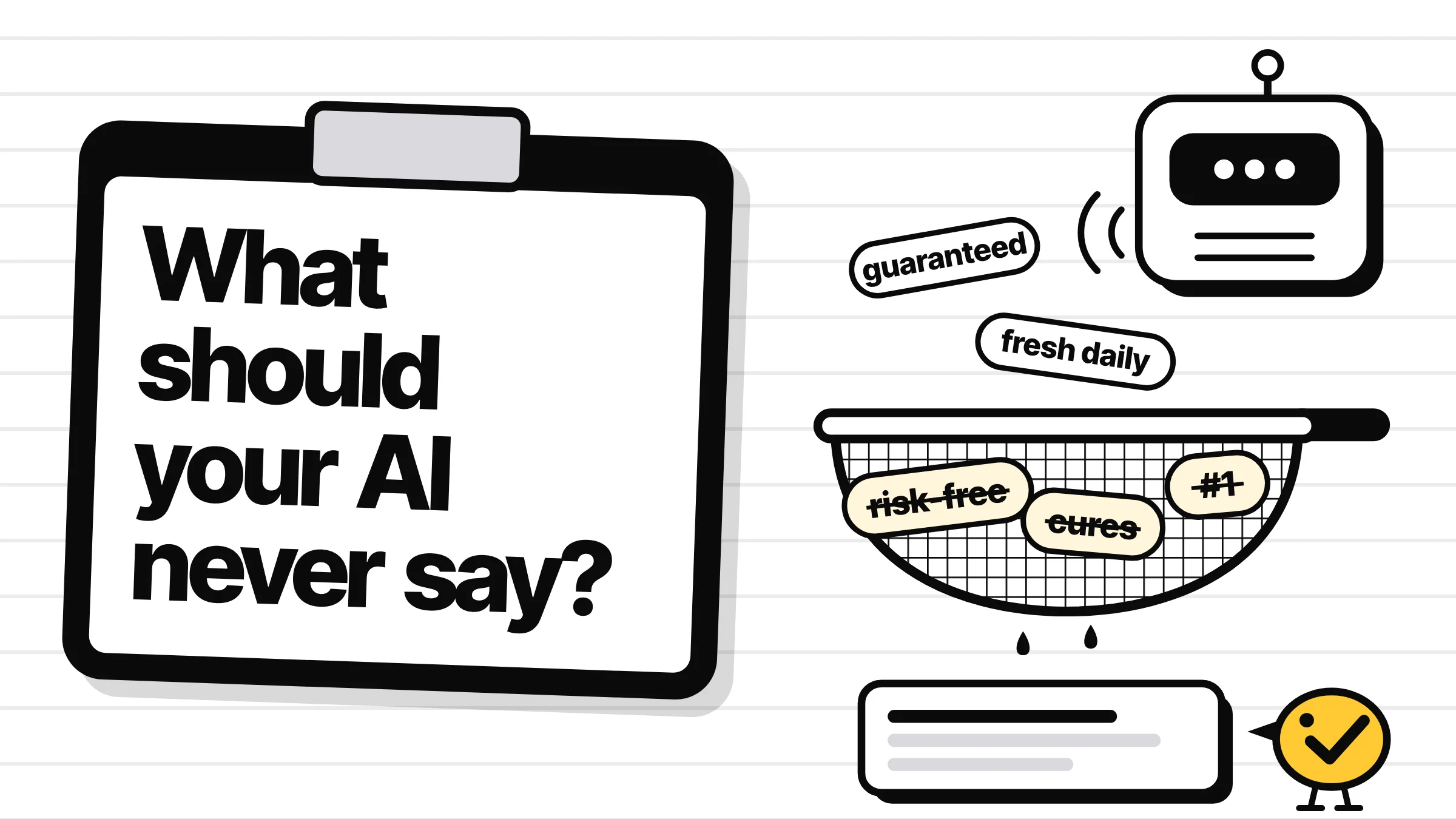
Give the AI short rules it can follow word for word: phrases it must never use, claims it may only make with proof you supply (results, health, money, "best", numbers and reviews), and your house style, each with the fix. Then have the tool that posts check every caption against the same list, because a prompt is a request the AI can miss, and a check blocks the post.
A brand guidelines AI prompt that actually holds
A good brand guidelines AI prompt is a short list of rules, not a page of adjectives. "Warm but professional" gives the AI nothing to check itself against. "Never say risk-free" does. Write three kinds of rules: words to never use, claims to make only with proof you hand over, and your house style. Give each one a fix, so the AI knows what to write instead. Then put the same list in the tool that saves or posts, so a caption that breaks a rule is stopped, not just discouraged.
Copy this into your assistant
Paste it where your assistant reads it on every chat: a ChatGPT project's instructions or a Claude project's instructions. Swap the brackets for your own.
Brand rules for every post you write for [Brand name]:

NEVER USE THESE WORDS OR PHRASES
synergy, cutting-edge, world-class, best-in-class, next level,
look no further, empower, risk-free, no risk, [add your own]
Instead: say it the way you'd say it to a customer at the counter.

CLAIMS YOU MAY ONLY MAKE IF I GIVE YOU THE PROOF IN THIS CHAT
1. Promised results: "you'll lose 5 kg", "double your bookings",
   any guarantee of an outcome. Say what the product does instead.
2. Health: that anything cures, treats, heals or prevents a condition.
   Softening it with "may help" doesn't make it OK.
3. Money: earnings, savings, returns or prices I didn't give you.
4. "Cheapest", "fastest", "number one", "most popular", "best-selling",
   or "best" about anything that can be measured. Give the fact instead.
5. Numbers, star ratings, review counts, awards, testimonials, quotes.
   Never invent one. Never write as if you were a customer.
6. Discounts, dates and stock ("20% off", "ends Sunday", "only 3 left")
   that I didn't give you.
If a post needs one of these and you don't have the proof, leave it
out and tell me what you left out.

HOUSE STYLE
* No em dashes. Use a comma, a colon or a full stop.
* No exclamation marks. End with a full stop.
* [No emoji / At most one emoji, at the end.]
* Hashtags: at most 3, at the end.
* Write like you talk: short sentences, plain words, "you" and "we".
House style is taste, so make it yours. Keep your hashtag rule at or under each platform's own cap: Instagram allows 5 per post, and Threads takes one topic tag. The claim rules aren't taste: they're where a post can break advertising rules.
Why each claim rule is there
Here is what the regulators' own pages say, in short. It isn't legal advice, and some fields (medicines, finance, alcohol) have stricter rules of their own; if you're unsure about a claim, ask someone who knows your field.
US and UK rules share one idea: if a reader would take a claim as fact, you need the proof before you post. The FTC's small business advertising guide says advertisers need "proof before the ad runs", online ads included. In the UK, CAP Code rule 3.7 says marketers "must hold documentary evidence" for claims consumers are likely to regard as objective, and the ASA says the code covers some material on a company's own social media: the posts about what you sell. An AI has none of your proof, so each rule says "only if I give it to you".
| Rule | AI writes | Write instead | Behind it |
|---|---|---|---|
| Results | "Clear skin in 7 days, risk-free." | "A 60-minute facial for oily skin." | FTC: proof before the ad runs; CAP 3.7 |
| Health | "Our ginger shot prevents colds." | "Ginger, lemon and honey, pressed this morning." | FTC: competent and reliable scientific evidence |
| Money | "Students earn $5k a month after our course." | "6 weeks, $199, and you'll finish with a portfolio." | FTC: back up your earnings (or lifestyle) claims |
| "Best" | "The cheapest wedding flowers in Leeds." | "Wedding bouquets from £45." | ASA: objective "best" claims need evidence |
| Reviews | "Rated 4.9 by 2,000 happy customers." | A real review, quoted with the customer's OK, or none. | FTC fake reviews rule; CAP 3.44 and 3.47 |
- Health. The FTC's Health Products Compliance Guidance counts social media as advertising. It says "it's not enough to say that the product 'may' have the claimed benefit" and "vague qualifying terms are inadequate". So "may help prevent colds" is the same claim, just quieter.
- "Best". Not every "best" is a problem. The ASA read "the best since 2004" on a pillowcase ad as an opinion, the kind of claim rule 3.2 allows as long as it doesn't materially mislead. But Three's "best value" iPhone deal, in an ad all about price, was read as "cheaper than any of its competitors", which needs proof. An AI can't tell which side of that line it's on, so the rule bans the measurable ones and lets you add "best" back yourself.
- Reviews. The FTC's 2024 rule bans reviews and testimonials that "misrepresent that they are by someone who does not exist, such as AI-generated fake reviews". A business that puts testimonials on its own website "is disseminating them", so it's on you, not the AI. And the FTC's endorsement Q&A says you "can't talk about your experience with a product if you haven't tried it", which is what an AI writing as a customer does. In the UK, CAP rule 3.44 bans fake consumer reviews and 3.47 says you must hold evidence a testimonial is genuine.
- Ads. If you pay to run a post as an ad, the platform's ad rules apply on top. Meta's health and wellness ad policy, for example, bans claims to cure, heal or eliminate a listed set of incurable diseases, such as diabetes and cancer.
The list is a starting point, not a compliance check.
A prompt asks. A check blocks.
A prompt helps, but it can be missed: a long chat where the rules scroll out of view, a pasted web page that says "best in town", a quick "make it punchier" that brings the exclamation marks back. With a prompt alone, you find the miss only by reading every post. (Why "ask me first" in a prompt isn't a gate either is in how to approve AI-generated posts.)
A check is different: the tool that saves the post runs every caption against your list and refuses the one that breaks it, whatever the AI was told and whichever assistant wrote it. Two things make checks work:
- Check what a machine can match. Exact phrases ("risk-free"), a family of words ("cures, heals, treats, prevents"), single characters (the em dash, exclamation marks, emoji). "Don't invent reviews" can't be matched by words, so it stays a written guideline, and that's what your approval is for.
- Give the exact words as the fix. "Say 'baked this morning' instead" can be fixed in one go, by the AI or by you. "Be less salesy" can't.
How this works in Yaybird
I built Yaybird so these rules live with the brand, not in each chat. Here's what the code does today:
- Every new brand starts with the General pack: no em dashes, a "no corporate filler" list, "no promises of results" ("risk-free", "no risk" and more), and a written guideline against testimonials or results from people who don't exist. Health and Real estate packs add in one go; the brand rules page lists them in full.
- Every assistant reads the same rules. Any AI app connected to Yaybird gets them with the brand, so nobody keeps three copies.
- An AI's caption that breaks a rule is refused, with the rule's name, the phrase it found and the fix. In the app the phrase is marked in amber, and when the fix names exact words, "Use this" puts them in.
- An AI can add rules but not loosen them. A new rule applies at once. Removing or editing one waits for an owner or admin to approve it.
Two honest gaps we found running our own packs against sample captions: the "no em dashes" switch catches the em dash but not the shorter en dash, so add that as a never-say phrase if you mind it. And the Health pack's cure rule caught "may help heal infections" but not "prevents colds", because colds aren't on its list of conditions. When you see a new miss, add a rule. Word rules are a net with holes. Your approval is the rest.
Questions
Where do I paste brand guidelines so the AI uses them every time?
Somewhere it reads on every chat, not in one message. In ChatGPT and Claude that's a project's instructions, which apply to the chats in that project. If you use several assistants, keep the rules in one place they all read, or you'll be editing three copies.
Does "may help" make a health claim safe?
No. The FTC's health guidance says it's not enough to say a product "may" have the benefit, and that vague qualifying terms are inadequate. If you can't back the claim, leave it out.
Can a word list catch every bad claim?
No. It catches the words you list and nothing else: a rule against "cures" won't catch "helps fight off colds". Use word rules for the misses you see again and again, and read each post for the rest before you approve it.
Drafted with AI from our research, fact-checked against the platforms' docs and our code, and reviewed by Hamza.

About the author
I build Yaybird, where your AI writes the posts and you approve them on your phone.