Social media scheduling 2027: what's actually changing
By HamzaPublished
In short
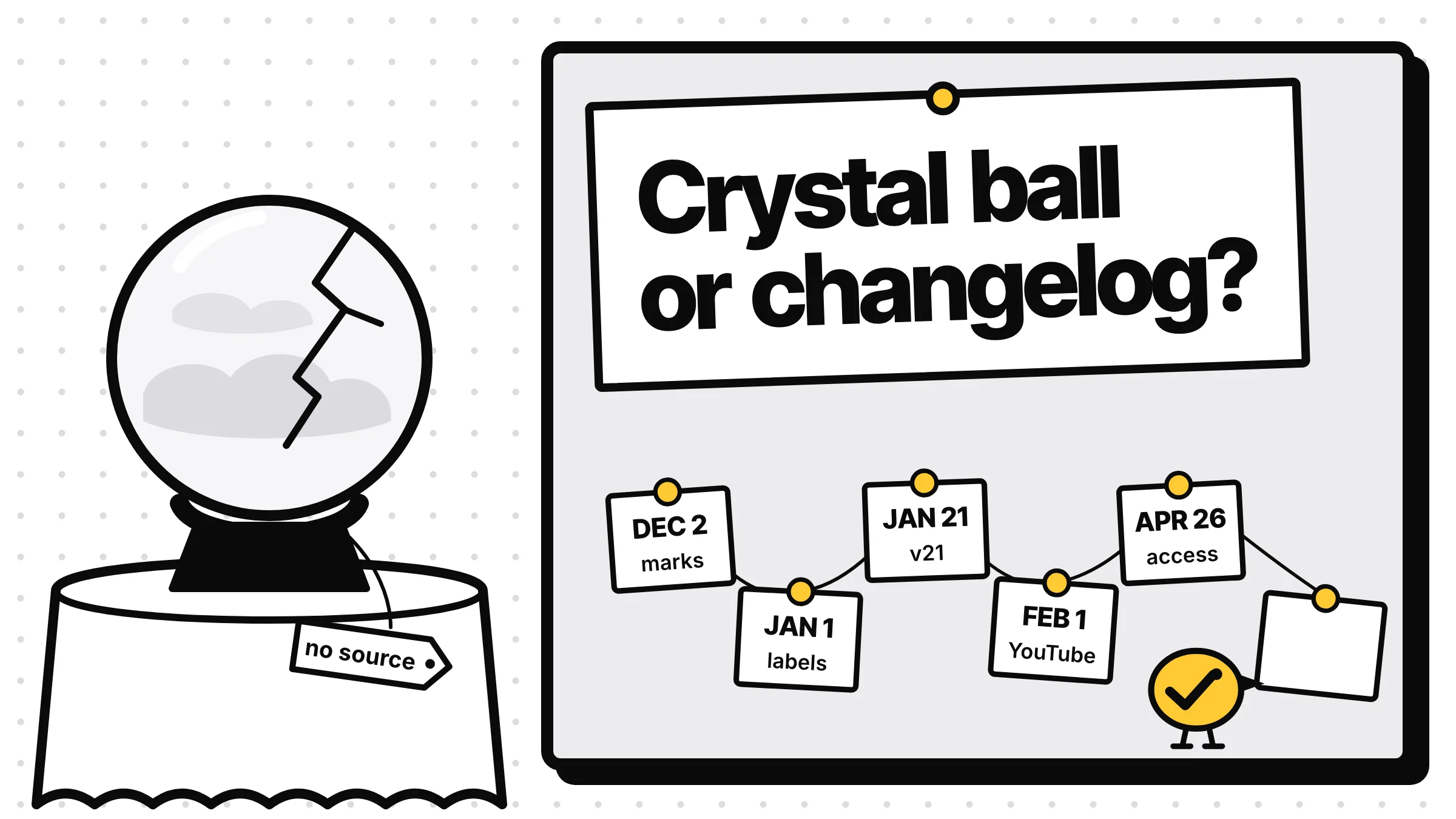
Scheduling keeps working in 2027. What changes, with dates: AI tools must mark what they make (EU, December 2, 2026) and big platforms must show those marks (California, January 1, 2027), YouTube's Partner Program changes on February 1, 2027, old Meta API versions switch off through the year, and larger US state and local governments must post accessibly from April 26, 2027.
Social media scheduling 2027: the dated changes
Most "social media scheduling 2027" articles are trend lists. This one only has what a platform or a regulator has written down with a date, checked on each source in late October 2026. The short version: scheduling keeps working. What changes is how AI-made posts get labelled, how YouTube decides who earns, which API versions still answer, and, for a few of you, accessibility rules.
| When | What changes | Whose duty, and what you notice |
|---|---|---|
| December 2, 2026 | AI tools already on sale in the EU must mark what they make as AI-made, in a way machines can read | AI tool makers. Your AI files arrive marked |
| January 1, 2027 | Platforms with 2 million+ monthly users must, under California law, detect those marks, show them, and not strip them | The platforms. Marked posts get labelled |
| January 21, 2027 | Meta switches off Graph API v21.0 (v22.0 goes May 20, v23.0 October 8) | Homemade workflows, older tools |
| January 31, 2027 | Last day to accept YouTube's new Partner Program terms | Monetized YouTube channels |
| February 1, 2027 | YouTube's new entry bar and activity rule | YouTube channels |
| April 26, 2027 | New social posts by US state and local governments of 50,000+ people must meet WCAG 2.1 AA | Those governments and anyone posting for them |
| Through the year | Old LinkedIn API versions stop working, each at least a year after it came out | Homemade LinkedIn workflows |
AI labels: they find your post now
The EU AI Act's transparency rules, Article 50, have applied since August 2, 2026. The Digital Omnibus on AI kept that date and added one grace period: AI tools already on sale before August 2 have until December 2, 2026 to mark their pictures, video, audio and text as AI-made in a machine-readable way.
That duty sits with the tool makers, not you. What it means for you is that from 2027, more of what ChatGPT, Gemini or an image app makes for you should arrive with a hidden mark. California adds the other half: from January 1, 2027, its AI Transparency Act (AB 853, as amended by AB 2713) makes platforms with over 2 million monthly users detect provenance data, show people whether it's there and which AI made the content, and not knowingly strip it where that's technically feasible.
Platforms already read those marks. TikTok's help page says it may auto-label content that carries C2PA Content Credentials, and you can't remove that label. YouTube's disclosure page says the same about C2PA labels. Meta labels images when it detects an industry-standard signal.
Your own part is smaller than it sounds:
- Platforms: Meta may require a label on photorealistic video and realistic-sounding audio, not images. TikTok asks you to label content made or significantly edited by AI, and YouTube requires one on realistic altered or synthetic content. A caption ChatGPT helped write needs none; YouTube says the same for scripts, titles and thumbnails.
- The EU, if you post to EU customers: Article 50(4) puts this part on whoever uses the AI tool for work: a deep fake (AI image, sound or video that resembles existing people, objects, places or events and would falsely appear genuine) must be disclosed. AI text needs a label only when it is published to inform the public on matters of public interest, and not when a person reviewed it and someone holds editorial responsibility.
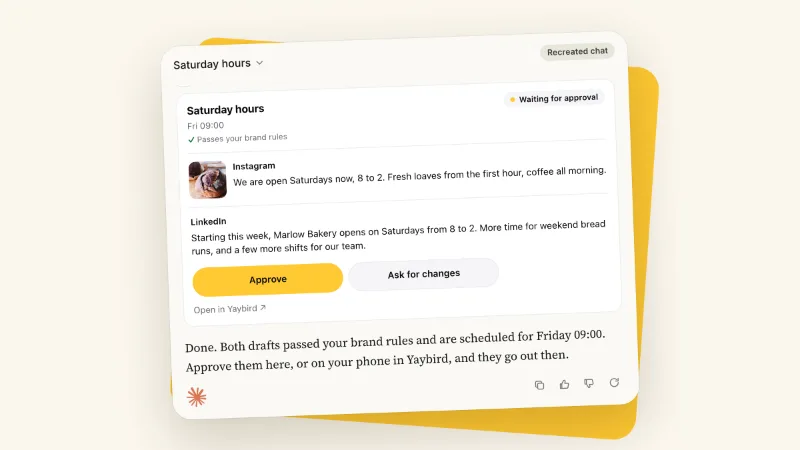
What to do now: turn on the AI label yourself for realistic AI images, video and voice, before the platform does it for you. Check that your scheduler sends it: Instagram's API has taken an is_ai_generated flag since June 22, 2026, YouTube has its synthetic media flag, and TikTok's API has is_aigc for videos and photos. The posting APIs of Facebook, Threads, LinkedIn and X document no label for regular posts, so you add it by hand there. In Yaybird, a post with a photo or video has an AI label switch; it goes to the platforms whose API takes one, and the post tells you where to add it by hand.
The EU's exception for reviewed text is one more reason to have a named person read and approve the exact version before it goes out. I wrote up how to approve AI posts properly.
YouTube: new rules on February 1, 2027
YouTube's Partner Program update is the biggest dated change for anyone who schedules video:
- Accept the new terms in YouTube Studio by January 31, 2027. If you don't, you stop earning from those features on February 1 until you do. You stay in the program.
- New channels need more to join: 1,000 subscribers plus 8,000 watch hours in the last 365 days, or 20 million Shorts views in 90 days. That's double today's bar. Channels already in the program aren't affected.
- Shorts pool earnings need 10 million Shorts views in the last 90 days.
- Staying active: a channel counts as active with 1,000 watch hours in a year, 1 million Shorts views in 90 days, or 2 long-form videos or 5 Shorts uploaded every 90 days. A channel that falls below gets 90 days to reach the watch hours or Shorts views to stay in.
What to do now: set a reminder for January to accept the terms. If your views are small, keep at least 2 videos or 5 Shorts every 90 days in your calendar, so a quiet season never drops you below the activity rule.
One more YouTube note for your 2027 reports: since August 24, 2026, YouTube counts a view from the first frame for every format, and says the Partner Program doesn't change. If you compare 2027 views with early 2026, the jump is partly the counting.
Old API versions switch off (if you built your own)
If you post through a scheduler, this is your tool's job. If you built a workflow in n8n, Make or code, it's yours.
Meta keeps each Graph API version for at least two years. Its version table ends v21.0 on January 21, 2027, v22.0 on May 20 and v23.0 on October 8. Calls to an ended version don't fail cleanly: Meta sends them to the oldest version still running, so a workflow can keep going and quietly behave differently. In n8n, the Facebook Graph API node has a Graph API Version field; set it to a current version. My n8n posting guide covers the rest of that setup.
LinkedIn is stricter. It ships an API version every month and keeps each for at least a year. After that, a call with the old version gets an error. If your workflow's LinkedIn-Version header is a year old, update it.
X: link posts cost more, replies are limited
Two 2026 changes on X shape what tools can offer in 2027. Since April 20, 2026, X's API charges $0.015 a post and $0.20 for a post with a link, over 13 times as much. It's why Yaybird caps X link posts per plan (20 a month on Creator, 60 on Business), and why other tools may too.
And since February 23, 2026, apps on X's self-serve plans can only reply to a post when its author mentioned or quoted the replying account, per the X API changelog. So if your tool won't reply to someone on X, that's likely X's rule. Reply in the app. The rest of X's automation rules are in what X allows apps to post.
What to do now: check your tool's X limits before you plan 2027, and save links on X for posts where the click matters.
Posting for a town, school or library: April 26, 2027
The US Justice Department's web accessibility rule covers state and local governments. One that hires an agency to run its accounts has to make sure the agency follows it too. After an April 2026 extension, governments of 50,000 people or more must meet WCAG 2.1 AA from April 26, 2027, and smaller ones and special districts from April 26, 2028. Social posts made before a government's date are exempt. Posts after it must meet the standard.
What to do now: alt text on every image, captions on every video, and nothing important that only exists inside a picture.
Announced, no date yet
- EU Digital Fairness Act. It targets misleading influencer marketing, among other things. In late October 2026 it was still only announced: the Parliament's research service expected the Commission's proposal in mid-November. A proposal then needs Parliament and Council, which takes into 2027 or later, so nothing from it has a 2027 date yet.
- AI apps posting for you. ChatGPT and Claude can connect to posting tools as custom apps built on MCP, and so can Gemini, in the US for now (setup for each AI app). None of the platforms' developer policies we read has a separate rule for AI agents. The existing ones apply: X's developer policy says a tool must show exactly what will be published, and TikTok's sharing guidelines need your express consent before upload. If you're choosing a tool for this, here's the best social media scheduler for AI agents.
Nothing else dated for 2027
As of late October 2026, the developer changelogs of Instagram, Threads, TikTok and Google Business Profile list no posting change dated 2027 beyond Meta's API dates above, and we found none for Pinterest or Bluesky. A 2027 rule without a link to the platform is a guess, so check its changelog before you change your plans.
Questions
Do I have to label captions that AI wrote?
Usually not. Meta asks for a label on realistic AI video and sound, TikTok and YouTube on realistic AI content, and YouTube says AI help with scripts and titles needs none. The EU AI Act asks for a label on AI text only when it is published to inform the public on matters of public interest, and not when a person reviewed it and someone holds editorial responsibility.
Will my scheduled posts stop going out in 2027?
Not because of anything announced so far. The risk is a tool or a homemade workflow still calling an old Meta or LinkedIn API version. If posts start failing or looking different after January 21, 2027, check that first.
Does the EU AI Act apply if my business isn't in the EU?
It can. Article 2 also covers businesses outside the EU when what their AI tool made is used in the EU, so posts your EU customers see can be in scope. Purely personal, non-professional use is outside it. This is a summary of the text, not legal advice; if a lot rides on it, ask a lawyer.
Drafted with AI from our research, fact-checked against the platforms' docs and our code, and reviewed by Hamza.

About the author
I build Yaybird, where your AI writes the posts and you approve them on your phone.